When Mobile Networks Fail, A Phone Can Still Reach Your Group
Originally published on su.ac.za on 30 April 2026 by Robert Kellerman (Content Creator) — Archived copy
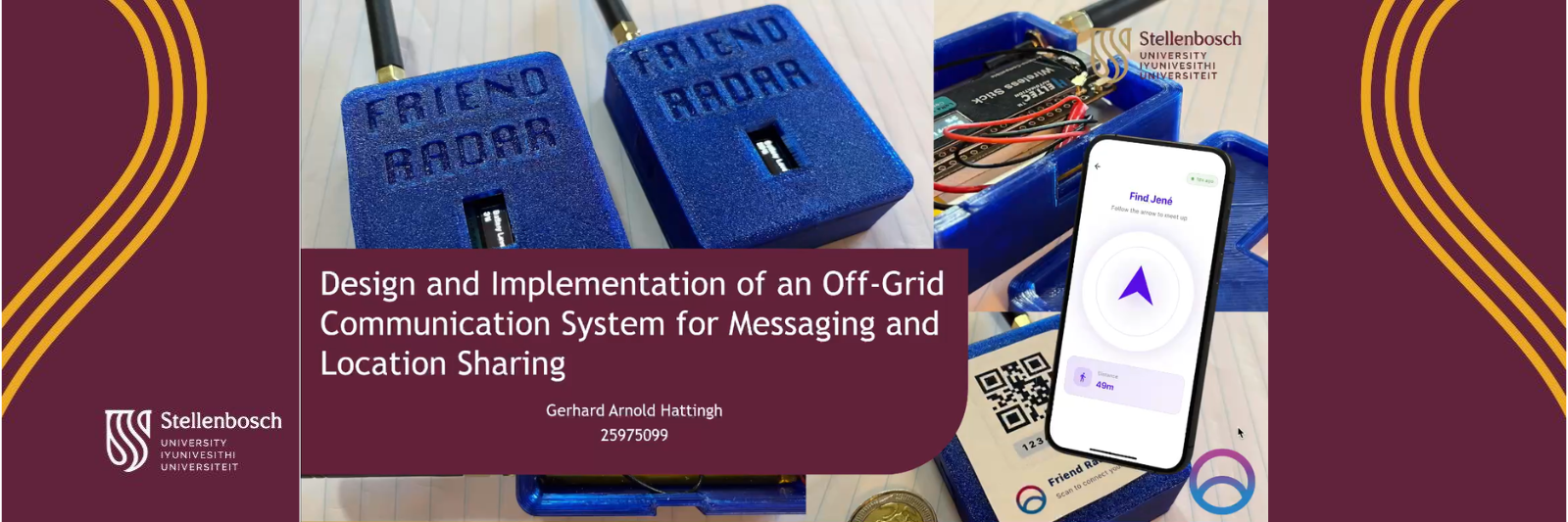
A final-year engineering project at Stellenbosch University explored how a smartphone can continue to function for basic communication when cellular or Wi-Fi networks are unavailable. The result was a two-part off-grid system that combines a mobile app with a compact LoRa device for messaging, location sharing, friend-finding, and low-resolution image transfer.
At a concert, sports event, or outdoor gathering, people often assume their phones will work when they need them. In practice, that can fall apart fast. If too many users crowd onto the same cellular network, messages stall, calls fail, and simple coordination becomes difficult. The same problem shows up in rural areas or on hiking routes where the signal is weak or missing altogether.
Gerhard Arnold Hattingh’s final-year engineering project looked at that gap and asked a practical question: could a smartphone keep working for basic communication without relying on cellular service or Wi-Fi? His answer was a two-part off-grid communication system built around a small external radio device and a mobile app.
A Two-Part Off-Grid System
The two-part off-grid communication system is built around a small external radio device and a mobile app, while the phone remains the familiar part of the system. Users still type messages, check locations, and follow on-screen directions. The difference is that the phone connects via Bluetooth Low Energy (BLE) to a separate handheld device that sends data over LoRa. LoRa is a long-range wireless system built for small amounts of data sent over much greater distances than ordinary Bluetooth. In this project, it carried text, location data, and low-resolution images without needing network infrastructure.
The hardware side used a Heltec Wireless Stick V3, which combines a microcontroller, LoRa radio, BLE support, and a small OLED display on one compact board. It was housed in a 3D-printed PETG case with an external antenna, a rechargeable battery, and a QR code for pairing. The result is a device small enough to carry with a phone, but capable of extending that phone’s range far beyond normal short-range wireless links. The companion app, built in Flutter, runs on both Android and iOS and handles group setup, messaging, image transfer, location sharing, and live friend-finding.
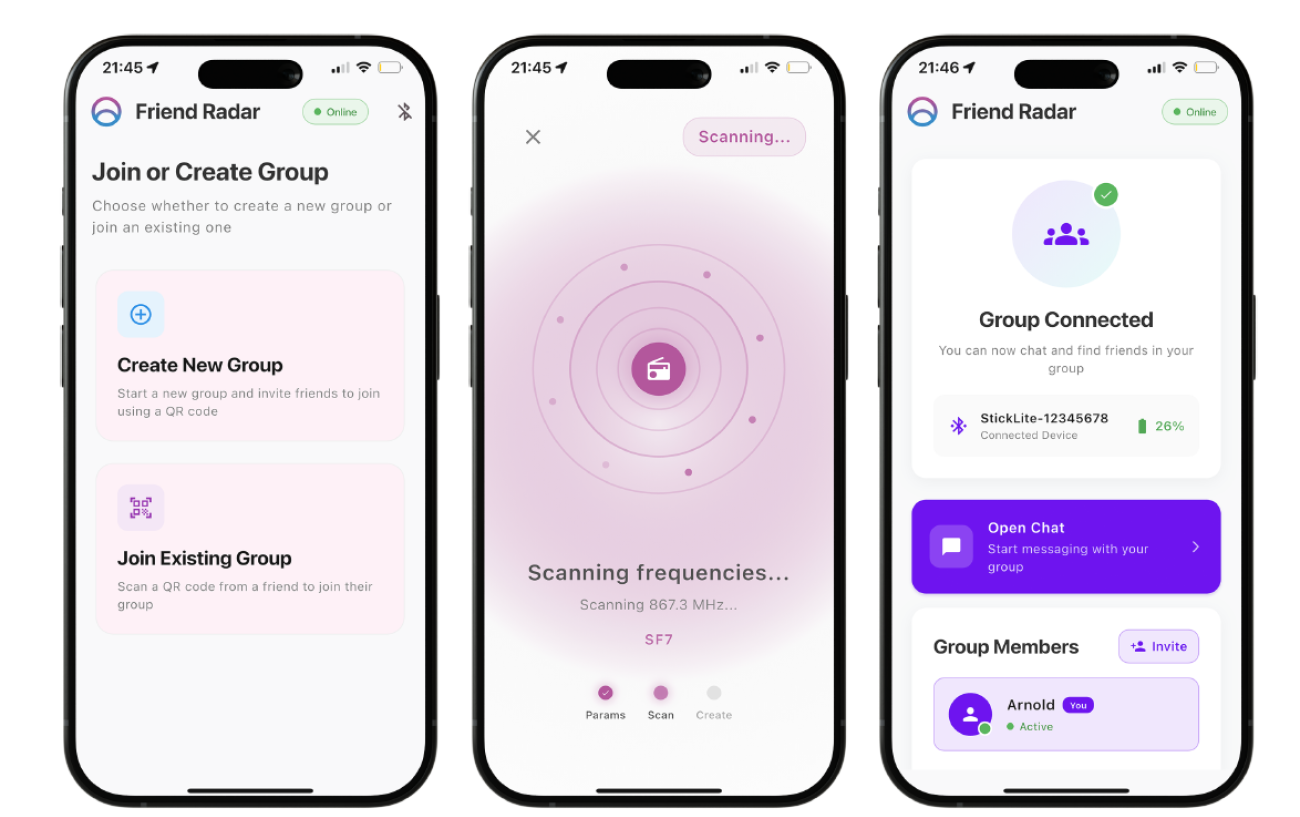
Fig 1: Key setup screens: joining or creating a group, scanning for a low-traffic frequency, and reaching the Home screen.
Keeping the Phone at the Center
One of the more thoughtful parts of the design is how it treats the smartphone as the main user interface. That keeps the system easier to use than a standalone gadget with its own buttons and menus. Users create or join a group, connect to their device, and start messaging through the app.
The software also supports location sharing and a compass-style screen that points a user toward another group member. To do that, it combines GPS coordinates with heading data from the phone’s sensors. It then calculates distance and bearing so the arrow on screen points toward the selected friend’s last known position.
Working within LoRa’s Limits
The project also addressed a basic technical problem with LoRa. It offers good range and low power use, but its data rate is limited. That makes it suitable for short text and coordinates, but it leaves little room for larger files.
Hattingh worked around that by compressing images into a simple 2-bit grayscale format. Each image is resized, converted to grayscale, dithered to preserve visible detail, and packed into small chunks that fit the LoRa payload limit. The system then reassembles those chunks on the receiving side. It’s a clear example of designing around the limits of the transport layer instead of ignoring them.
Securing Messages and Group Data
Security was also part of the design. The system encrypts transmissions end-to-end using ChaCha20-Poly1305, an authenticated-encryption method. In plain terms, that means it protects both confidentiality and message integrity. In other words, a person intercepting the radio traffic can capture the data, but without the correct key they can’t turn it back into a readable message.
Group details shared through QR codes are used to derive the keys needed for devices in the same group. Tests in the report showed that intercepted packets appeared as unreadable encrypted data unless the proper decryption method and key were available.
Read the original article on the SU website: https://www.su.ac.za/en/faculties/engineering/departments/electrical-electronic-engineering/news/when-mobile-networks-fail-phone-can-still-reach-your-group